
Chores by age: what kids can actually handle
A realistic chore table from age 2 to 14, plus how to teach a job once so you don't end up redoing it forever.
 The Parent ChroniclesOct 15, 2026 · 4 min read
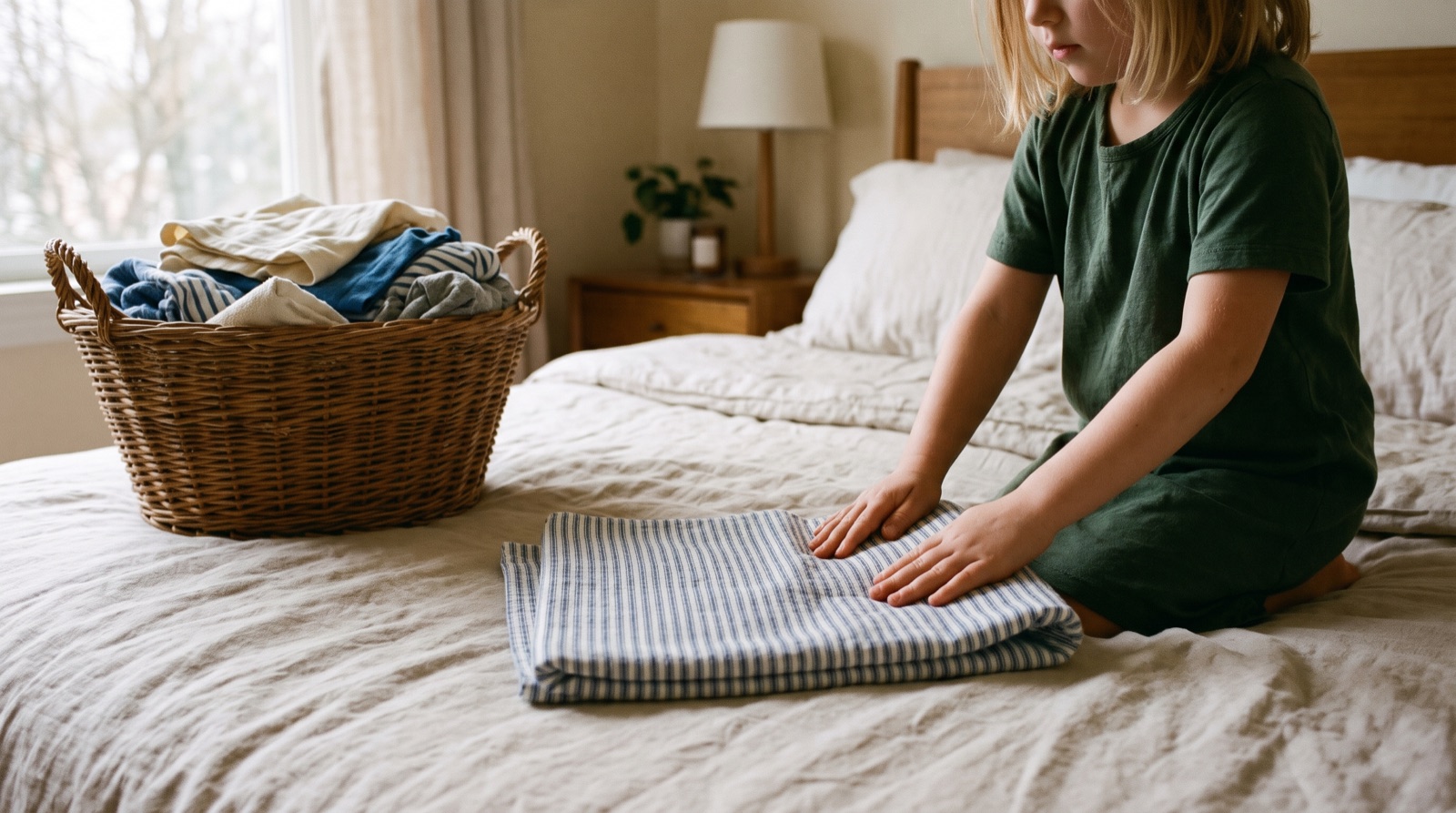
Kids can do more than we usually ask of them. They also do it slower, messier and with more complaining than if we just did it ourselves. That’s the whole tension of chores: the short-term math says “I’ll do it,” and the long-term math says “they need to learn.”
Here’s a realistic guide to what kids can typically handle at each age, plus how to make it stick without turning every Saturday into a negotiation.
A few ground rules first
- Every kid is different. Use the table as a starting point, not a test. Kids with motor, attention or developmental differences may need jobs broken into smaller steps or adapted, and that’s completely fine.
- “Can do” isn’t “can do perfectly.” A four-year-old’s made bed will look like a four-year-old made it. Let it.
- Ages overlap. Anything on a younger row is fair game for older kids too.
The table
| Age | Chores they can usually handle |
|---|---|
| 2–3 | Put toys in a bin, put dirty clothes in the hamper, wipe up small spills with help, carry their cup to the counter, feed a pet with you measuring |
| 4–5 | Set the table (non-breakables), match socks, make their bed loosely, water plants, put away their own clothes in low drawers, help unload cutlery from the dishwasher |
| 6–7 | Sort laundry by color, sweep a small area, pack part of their school bag, help put away groceries, clear their plate and scrape it, tidy their room with a checklist |
| 8–9 | Fold and put away their own laundry, load the dishwasher, take out recycling, make simple snacks, vacuum a room, feed pets on their own |
| 10–11 | Clean a bathroom sink and mirror, run the dishwasher start to finish, help cook a simple meal, change their bed sheets, mow a small lawn with supervision |
| 12–14 | Do a full load of their own laundry, cook a simple dinner once a week, clean a whole bathroom, babysit a younger sibling for short stretches, manage their own schedule and gear |
If you look at that last row and think “my 13-year-old can’t find their shoes,” you’re not alone. Start where they are and work up.
Teach it once, properly
Most chore battles come from jobs that were never really taught. “Clean your room” is not one task. It’s twelve. Break it down:
- You do it, they watch. Talk through each step.
- You do it together. They do the easy parts, you do the tricky ones.
- They do it, you watch. Bite your tongue. Only step in if something’s unsafe.
- They do it alone. Check in afterward, not during.
This takes a week or two for each new job. It saves you years of redoing it.
Make it visible
Kids don’t keep invisible lists in their heads. Neither do most adults. A few things that help:
- A chart on the fridge with pictures for pre-readers and words for older kids.
- Checklists inside cupboards or on doors. “Room is tidy when: floor clear, bed made, clothes in hamper, books on shelf.”
- Chores tied to existing moments. “After breakfast, plates go in the dishwasher” sticks better than “sometime today.”
Reminders without the nagging
The hardest part of chores often isn’t the chore. It’s being the person who has to remind about it, again, for the fourth time. A few ways to take yourself out of the role of broken record:
- Let the routine do the reminding (“What happens after dinner?” instead of “Clear your plate”).
- Use a timer or alarm for recurring jobs, like feeding the dog at 6 pm.
- For older kids with phones, set reminders that go to them directly.
One option for that last one is Nudga, an app that sends a reminder and keeps following up until the person confirms it’s done, and can escalate to a text, a call, or another family member if nobody responds. Push and email reminders are free. (Full disclosure: Nudga is made by the same small team behind Parent Chronicles.) A shared phone alarm or a whiteboard works too. The point is that the reminder comes from somewhere other than your voice.
Should you pay for chores?
Families genuinely differ on this, and there isn’t one right answer. A common middle path:
- Some chores are just part of living here. Everyone clears their plate, everyone keeps their room livable. No payment, because nobody pays you to make dinner.
- Extra jobs can earn money. Washing the car, raking all the leaves, organizing the garage. This gives older kids a way to earn and learn about money without making basic contribution optional.
Whatever you choose, be consistent, and be clear about which jobs are which.
When they push back
They will. A few things that tend to help:
- Offer choices inside the chore. “Do you want to do the dishes or the bathroom sink?” Both are chores. They still get to pick.
- Work alongside them. “Ten-minute tidy” with music and everyone moving at once feels less like punishment.
- Notice effort, not perfection. “You remembered the recycling without me asking” goes a long way.
- Let natural consequences happen. If the soccer kit didn’t make it to the laundry, it’s dirty on Saturday. That’s usually a one-time lesson.
The real goal
Chores aren’t really about a clean house. They’re about a kid who grows into an adult who can feed themselves, wash their own clothes and notice when the bin is full. Every lopsided towel fold is a small step toward that. Leave it lopsided. They’ll get there.
Keep reading

Screen time rules that survive a real household
Forget the perfect screen policy. Here's an approach that holds up on a Tuesday, when you're cooking dinner and someone needs the tablet.
The Parent ChroniclesOct 12, 2026 · 4 min read
Gentle parenting is not permissive parenting
Warm and firm can live in the same sentence. What gentle parenting actually means, and what it looks like at 7 pm when nobody wants to brush their teeth.
The Parent ChroniclesOct 9, 2026 · 4 min read