
When both parents work: the logistics nobody talks about
Shared calendars, handoffs and the invisible mental load. A practical system for two working parents who are tired of being surprised by spirit week.
 The Parent ChroniclesOct 18, 2026 · 4 min read
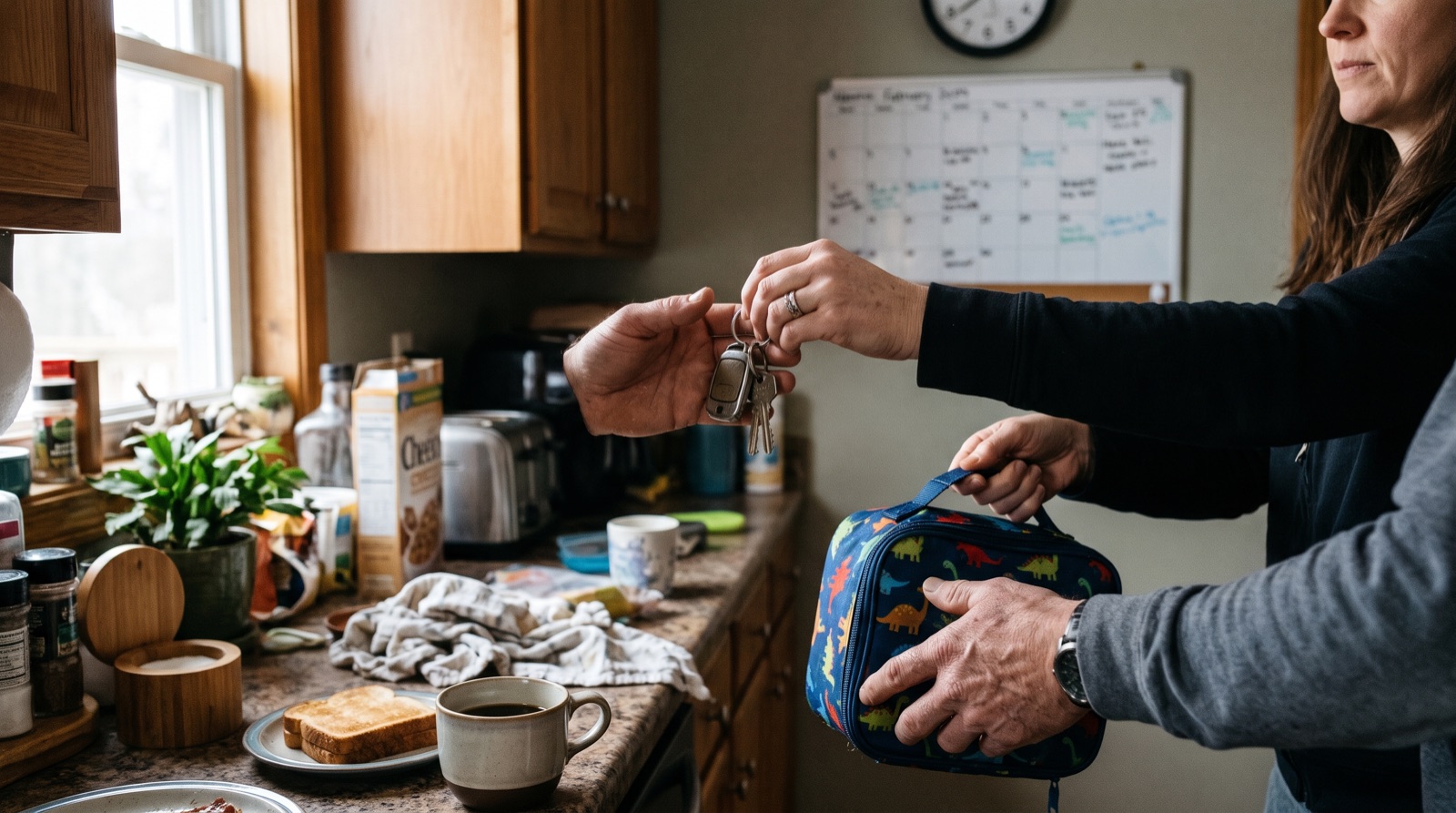
The hard part of two working parents isn’t usually the work. It’s the forty small things around it: who’s doing pickup on Thursday, who signed the field trip form, who noticed the kid has grown out of every pair of shoes. None of these are big. All of them together can quietly swallow a marriage’s goodwill.
Here’s how to make the logistics visible, shared and a little less exhausting.
Name the mental load out loud
The “mental load” is the work of remembering, planning and noticing, as opposed to doing. Packing the lunch is doing. Knowing that Friday is pizza day, that the lunchbox has a crack, and that the yogurt runs out tomorrow is the mental load.
In a lot of households, one parent carries most of it without anyone deciding that. It just happened. The first step is to say it plainly, without blame: “I feel like I’m the one tracking everything, and I’m running out of room.”
Try this together on a quiet evening. Each of you writes down every recurring family task you can think of: appointments, school forms, birthday gifts, meal planning, the car’s oil change, the dog’s vaccines. Then compare lists. Most couples are surprised, in both directions.
Own whole jobs, not pieces
“Can you help with dinner?” keeps one person as the manager. Owning a whole job removes that.
Instead of splitting tasks, split domains. If one parent owns “kids’ medical,” that means they book the checkups, remember the forms, fill the prescriptions and know when the next dentist visit is. The other parent doesn’t have to think about it at all.
Some domains to divide:
- School (forms, events, teacher emails, spirit days)
- Medical and dental
- Activities and sports
- Meals and groceries
- Birthdays and gifts
- Household admin (bills, insurance, car, repairs)
Domains don’t have to split fifty-fifty by count. They should feel fair by effort. Revisit every few months, especially when a job changes or a new kid arrives.
One calendar, one source of truth
Two separate calendars plus a paper one on the fridge equals three calendars that disagree. Pick one shared digital calendar that both of you can edit and both of you actually check.
A few habits that make it work:
- If it’s not in the calendar, it doesn’t exist. Gentle, firm, and life-changing.
- Add things the moment you hear about them. The school email arrives, the event goes in, before you close the email.
- Color-code by person, so a glance shows who’s busy when.
- Put the handoffs in too. “Pickup: A” and “Pickup: B” are calendar events, not assumptions.
The Sunday ten minutes
Once a week, sit down together for ten minutes. Not an hour. Ten minutes, ideally with coffee or after the kids are in bed. Go through the coming week:
- Who’s doing each drop-off and pickup?
- Any late meetings, travel or early starts?
- Any school events, forms or special items (costume, cash, a shoebox for a diorama)?
- What’s for dinner on the two busiest nights?
This one habit prevents most of the 7:40 am “Wait, who’s taking her?” moments.
Design for the handoff
Picture the 7:40 am scramble: one parent has an early meeting, the other is doing drop-off, and nobody knows where the library book is. A few small systems help:
- A launch pad by the door. Backpacks, shoes and anything that needs to leave the house go in one spot the night before.
- A handoff note. If one parent is doing the evening alone, a quick message covers it: “Swim bag is in the car, she still needs to read for 15 minutes, he had a rough afternoon.”
- Duplicate the critical stuff. A second car seat, a spare school uniform, a backup charger. It costs a little and saves a lot of driving back home.
Reminders that don’t depend on one brain
When one person is the family’s memory, they’re also the single point of failure. Shared reminders spread that load: medication times, the permission slip due Friday, the payment for after-school care.
Nudga is one option here: it sends a reminder and keeps following up until someone confirms, and if nobody responds it can escalate to a text, a call, or the other parent. Push and email reminders are free. (Full disclosure: Nudga is made by the same small team behind Parent Chronicles.) Shared calendar alerts or a whiteboard by the door can do a lot of the same job.
Plan for the sick day before it happens
The sick-day call from school will come at the worst possible moment. Decide ahead of time:
- Who covers the first day, and how you’ll decide (whose schedule is more flexible that week, alternating, or splitting the day)
- Who your backup people are: a grandparent, neighbor or friend who can step in
- Which work tasks can move, and who at work needs to know
Having the conversation once, calmly, beats having it in a tense phone call at 10:15 am.
Protect a little time that isn’t logistics
When both of you work, the relationship can turn into a project-management meeting that never ends. Guard a small slice of time where you don’t talk about the calendar at all. A walk. A show you watch together. Ten minutes on the porch.
The logistics will never be finished. That’s fine. The goal isn’t a perfectly run household. It’s two people who feel like they’re on the same team, and who are both still standing by Friday.
Keep reading
Two homes, one birthday cake
Our son's first birthday after the separation. Two houses, two parties, one cake, because neither of us could stand the idea of him blowing out candles without the other there. His dad drove it over at noon and stayed for the song. It was a little lopsided and a little awkward, and our son didn't notice either of those things.

Caring for your kids and your parents at the same time
The sandwich generation's survival kit. How to keep track of two generations' needs without losing yourself in the middle.
The Parent ChroniclesOct 23, 2026 · 4 min read
Co-parenting across two homes
Consistency without control. How to give your kids steady ground across two houses, even when you and your co-parent do things differently.
The Parent ChroniclesOct 20, 2026 · 4 min read