
ADHD-friendly mornings: build the routine around the brain you have
If your mornings run on repeated reminders and rising voices, the problem may be the routine, not the kid. Visual cues, fewer decisions and outside help can change that.
 The Parent ChroniclesOct 1, 2026 · 5 min read
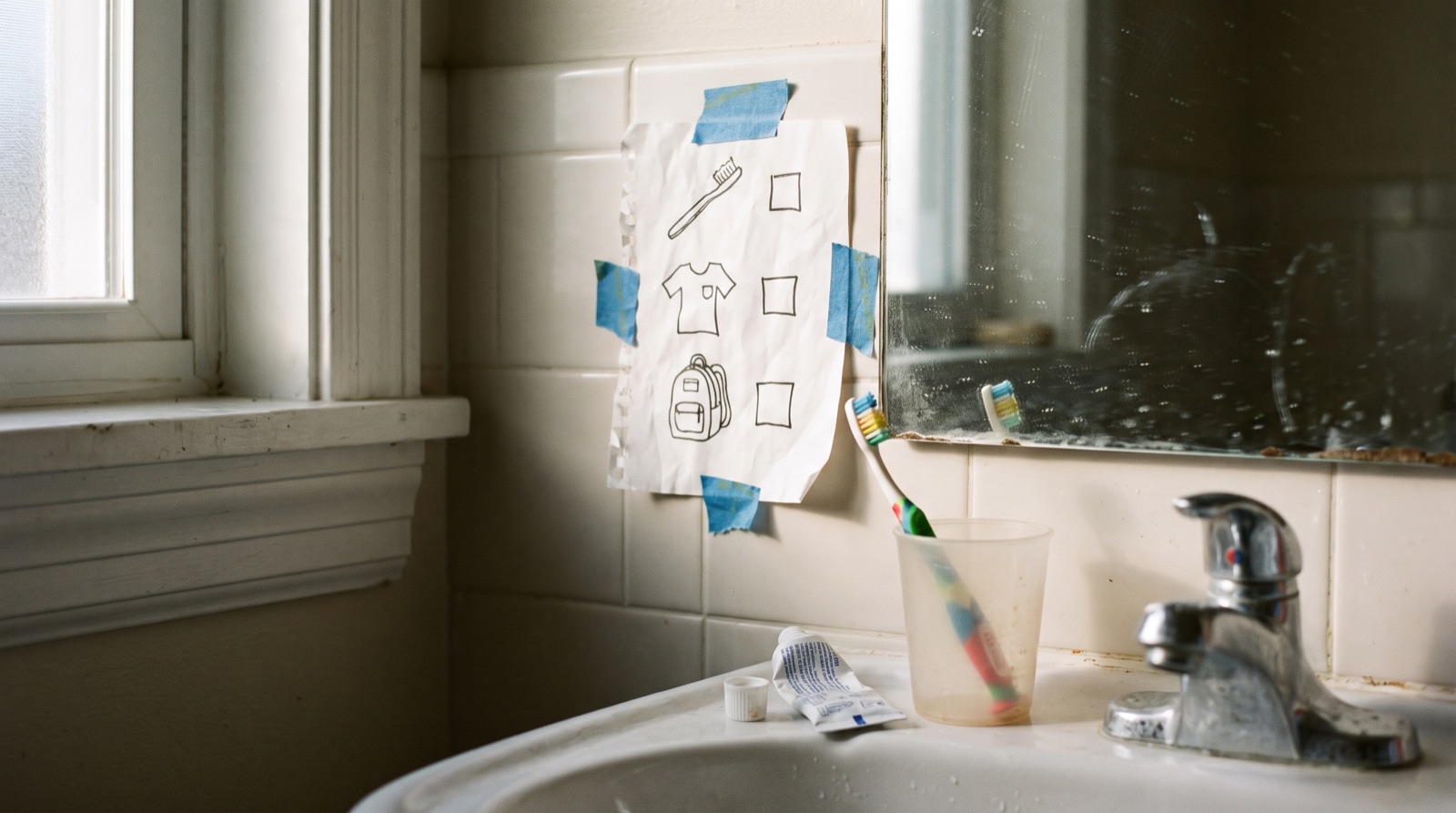
Picture the 7:40 am scramble. One shoe is on. The other is somewhere. Breakfast is half eaten because something more interesting appeared on the cereal box. You’ve said “teeth!” four times, each a little louder. Everyone is late, everyone is frustrated, and you’re already tired before the day starts.
If your child has ADHD, or you suspect they might, this may sound familiar. Here’s the thing that helps most: stop trying to make your kid fit the routine, and start building the routine around how their brain actually works.
Why mornings are so hard
ADHD is often described as a difference in executive function: the skills we use to plan, start tasks, hold steps in mind, manage time and switch from one thing to another. Mornings ask for every one of those, quickly, and usually before breakfast.
So when a kid wanders off mid-sock, it’s rarely defiance. It’s often that “put on socks” fell out of their working memory the moment something else caught their eye. Repeating the instruction louder doesn’t fix that. Changing the environment can.
(A note: if you’re wondering whether your child has ADHD, your pediatrician is a good first stop. They can talk through what you’re seeing and point you toward an evaluation if it makes sense. And everything below can help kids who just find mornings hard, diagnosis or not.)
Make the steps visible
Spoken instructions disappear the moment you say them. Visual ones stay put.
- A picture checklist. A simple strip of images for each step: toilet, clothes, breakfast, teeth, shoes, backpack. Put it where the step happens. Tape the teeth picture next to the bathroom mirror and the shoes picture by the door.
- Movable checkboxes. Some kids love flipping a card, moving a magnet or sliding a clip down the list. The physical act of “done” helps.
- One step at a time. A long list can feel overwhelming. If that’s the case, try showing only the next step or two.
Then, instead of telling them what to do, you can point and ask, “What’s next on your chart?” It turns you from the nag into the coach.
Make time visible too
For a lot of kids with ADHD, time is slippery. “Five minutes” can feel like an hour or like nothing at all.
- Use a visual timer that shows time running out, like a disk shrinking or sand draining.
- Anchor steps to something concrete. “Get dressed before the song ends” is easier than “get dressed in four minutes.”
- Build in a buffer. Plan to be ready ten or fifteen minutes before you need to leave. Something will always go sideways.
Cut the decisions
Every choice in the morning is a chance to get stuck. Move as many as possible to the night before, when there’s less pressure.
- Clothes picked and laid out, down to the socks.
- Backpack packed and hanging by the door.
- Breakfast limited to two or three easy options, ideally the same most days.
- Shoes always live in the same spot. (Yes, always. A basket by the door can save hours a year.)
Fewer decisions means less to remember, less to argue about and fewer opportunities for the day to derail.
Bring in outside reminders
Your voice is one cue among many, and it gets tuned out fast. Different reminders from different sources can work better.
- Alarms with labels. A phone or smart speaker reminder that says “Shoes and jacket now” lands differently than you saying it for the third time.
- Music as a timer. A morning playlist where each song is a step: one song for dressing, one for breakfast, one for teeth.
- A reminder system that follows up. For older kids and teens, a reminder that keeps nudging until they confirm can build independence without you hovering. One option is Nudga, which sends a reminder and keeps following up until someone confirms; if no one does, it can escalate to a text, a call or another family member. Push and email reminders are free. (Full disclosure: Nudga is made by the same small team behind Parent Chronicles.) Plain labeled alarms work well too; the point is that the reminder isn’t always you.
If your child takes medication, ask their doctor about timing. Mornings can look very different depending on when it’s taken, and that’s a question for the prescriber, not the internet.
Reduce friction, not expectations
Small physical changes can make a big difference:
- Keep distractions out of the morning path. Devices stay off until everyone’s ready, if that works for your family.
- Put a hook for the backpack at kid height, right by the door.
- Keep a spare set of everything that tends to go missing: hair ties, a jacket, a water bottle.
- Let them get dressed in the kitchen, the living room, wherever they actually stay on task.
None of this lowers the bar. It just clears the path to it.
Celebrate what works
Kids with ADHD often hear a lot of correction. Notice the good stuff, out loud and specifically: “You got your shoes on the first time I asked. That really helped us.” Some families use a small reward for checking off the full list, if that motivates your kid. Keep it simple and positive.
Expect good days and hard days
No routine works every day. Bad sleep, a change in schedule or a stressful week at school can knock things off course. When that happens, it’s not a sign the system failed. Adjust, simplify and try again tomorrow.
If mornings stay really hard despite your best efforts, or if school and home are both struggling, it’s worth talking to your pediatrician, a therapist who works with kids with ADHD or your child’s school. You don’t have to figure this out alone.
The goal isn’t a perfect morning. It’s a morning where your kid knows what’s next, you’re not the only reminder in the house and everyone gets out the door with a bit more of their good mood intact.
Keep reading

Sensory-friendly outings that actually work
Planning a day out with fewer meltdowns (for everyone). A practical guide to timing, escape routes and the bag that saves the afternoon.
The Parent ChroniclesOct 6, 2026 · 4 min readThe day I stopped apologizing for my daughter's stims
Today at the grocery store my daughter flapped her hands and hummed all the way down the cereal aisle because she found the "good" oatmeal. A woman stared. For years I would have apologized. Today I just said, "She's happy," and kept pushing the cart. My daughter never noticed the woman at all. She was too busy being thrilled about oatmeal.

The IEP meeting, demystified
A table full of professionals, a stack of reports and a lot of acronyms. Here's what to bring, what to ask and what you're allowed to say at your child's IEP meeting.
The Parent ChroniclesOct 4, 2026 · 5 min read