
How to ask for help (and actually take it)
For the parent who always says "I'm fine, thanks." A practical guide to asking for help, with scripts you can copy, and how to accept it without guilt.
 The Parent ChroniclesNov 12, 2026 · 4 min read
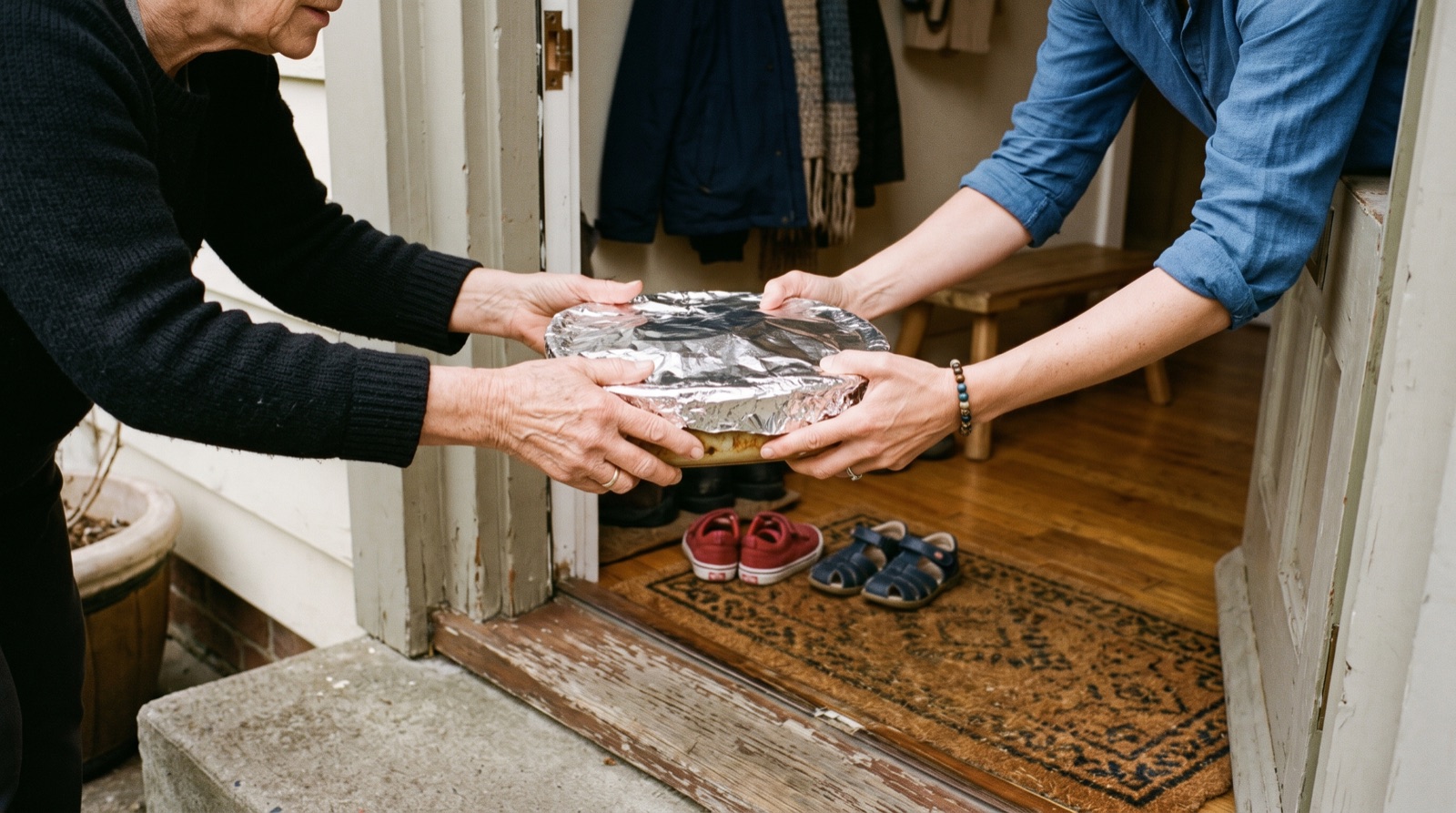
You know the moment. Someone says, “Let me know if you need anything!” And you say, “Oh, thank you, we’re fine!” And then you go home and eat cereal for dinner standing over the sink, with a sick kid on your hip and a pile of laundry the size of a small car.
If that’s you, this piece is for you.
Why asking is so hard
There are a lot of reasons parents don’t ask for help, and most of them sound like this:
- “Everyone else seems to manage.”
- “I don’t want to be a burden.”
- “It’ll take longer to explain than to just do it.”
- “They didn’t really mean it.”
- “If I ask, it means I’m failing.”
None of these are true in the way they feel true at 9 pm. Most people who offer help mean it. Most of them would genuinely prefer a specific job to a vague offer. And every parent who looks like they’re managing is quietly getting help from somewhere, or quietly drowning.
Turn “anything” into something
The biggest barrier is that “let me know if you need anything” puts all the work on you. You have to figure out what you need, decide who to ask, and work up the nerve. That’s a lot of steps for someone who’s already exhausted.
So make it easy for yourself. Keep a short list, on your phone or the fridge, of specific things other people could actually do:
- Pick up the kids from school on Tuesdays
- Drop off a meal (any meal, store-bought counts)
- Take the kids to the park for an hour on Saturday
- Fold one load of laundry
- Pick up a prescription
- Sit with the baby while you shower
- Walk the dog
- Come over and just be an adult in the room
When someone offers, you look at the list and pick one. No thinking required.
Scripts you can steal
The words are often the hardest part, so here are some you can copy and paste.
When someone offers:
“Actually, yes. Would you be able to pick up [kid] from school on Thursday? That would be a huge help.”
When no one has offered, but you need it:
“This is a hard week for us. Would you have an hour on Saturday to take the kids to the park so I can catch up on sleep? Totally fine if not.”
When you need a meal:
“We’re running on empty this week. If you’re up for dropping off dinner one night, we’d be so grateful. Anything at all.”
When you need emotional support:
“I’m having a rough time. Could we talk on the phone this week? I don’t need advice, I just need to say it out loud to someone.”
Notice what these have in common: specific, small, time-limited, and easy to say no to. That last part matters. When people know they can decline, they’re more likely to say yes.
Then, actually take it
Asking is step one. Accepting is a whole second skill, and for many parents it’s even harder.
Let them do it their way. If a friend folds the towels wrong or brings a casserole your kids won’t eat, say thank you and let it go. The point is the help, not the method.
Don’t clean before they come. Someone dropping off dinner does not need to see a tidy house. They need to see a tired parent at the door, which is exactly why they came.
Don’t immediately pay it back. You’ll get a chance to return the favor someday. Right now, the most gracious thing you can do is say “thank you, this really helped” and mean it.
Say what helped. “Having an hour to myself on Saturday was the first time I felt human all week.” People love knowing their help mattered, and it makes them more likely to offer again.
Help is a two-way street
Asking for help isn’t taking from people. It’s how communities are built. When you let someone help you, you give them permission to ask you for help later. You’re building the network your family will lean on for years, one Tuesday pickup at a time.
When it’s more than a rough week
Sometimes what’s going on is bigger than a pile of laundry. If you’ve felt persistently low, hopeless or numb for more than a couple of weeks, or you’re having thoughts of harming yourself, please reach out to your doctor right away. That’s not a failure either. It’s exactly the kind of help that exists for this.
For new and expecting parents in the US, the National Maternal Mental Health Hotline is free and confidential, 24/7, at 1-833-852-6262. If you are ever in immediate danger, call 911 or 988, the Suicide & Crisis Lifeline.
Start small
You don’t have to overhaul your life this week. Pick one thing from your list. Pick one person. Send one text.
Then let them help.
Keep reading

Checking on the parents in your life
A friend has a new baby, a sick kid or just a brutal season. Here are small, specific ways to show up that actually help, and how to keep showing up.
The Parent ChroniclesNov 17, 2026 · 4 min read
Building a village when you moved away from yours
No grandparents down the street, no old friends on call. How to find your people from scratch, one awkward hello at a time.
The Parent ChroniclesNov 15, 2026 · 4 min readThe neighbor who brought soup
Both kids had the stomach bug, my partner was away and I hadn't slept in two days. Someone knocked. It was the neighbor I'd only ever waved at, holding a pot of soup and a box of crackers. She said, "I could hear the coughing through the wall," and left before I could cry. I'm returning the pot tomorrow, full of cookies.