
Checking on the parents in your life
A friend has a new baby, a sick kid or just a brutal season. Here are small, specific ways to show up that actually help, and how to keep showing up.
 The Parent ChroniclesNov 17, 2026 · 4 min read

When a friend’s life gets hard, most of us want to help. A new baby, a child in hospital, a divorce, a parent’s diagnosis, a stretch of plain exhaustion. We care. We just don’t always know what to do, so we send “thinking of you!” once, and then life swallows us up.
This piece is about doing a bit better than that, without needing to be a saint.
Why “let me know if you need anything” doesn’t work
It’s kind. It’s sincere. And it almost never gets taken up.
Asking for help means your friend has to work out what they need, decide whether you meant it and summon the nerve to ask. When they’re running on no sleep, that’s too many steps. So they say “we’re fine,” and you both move on.
The fix is to do the thinking for them. Offer something specific, small and easy to say yes or no to.
Specific offers that actually help
For friends with a new baby:
- “I’m dropping off dinner Thursday. Any allergies? I’ll leave it on the porch and text you.”
- “Can I come hold the baby for an hour on Saturday so you can sleep or shower?”
- “I’m going to the store. Text me three things you need and I’ll bring them by.”
For friends with a sick or hospitalized child:
- “Can I take your other kids for the afternoon?”
- “I’d like to send you a gas card or food delivery credit. Which would be more useful?”
- “Want me to start a meal sign-up so you don’t have to coordinate it?”
For friends going through a hard season:
- “I’m free for a walk Sunday morning. No need to talk about anything.”
- “Want me to pick up the kids from school one day this week?”
- “No need to reply, just letting you know I’m thinking about you today.”
That last one is underrated. A message that explicitly doesn’t need an answer is a gift to someone who’s overwhelmed.
Small things that add up
Big gestures are lovely, but the steady small stuff is what people remember.
- Drop-offs without visits. Leave coffee, muffins or a bag of groceries on the doorstep. Text, don’t knock.
- Practical gifts. Frozen meals, paper plates, snacks for the kids, a phone charger for a hospital stay.
- Kid help. Pick-ups, playdates, a ride to practice. Taking a sibling for a few hours can be the biggest gift of the week.
- Admin help. Offer to make phone calls, organize a meal train or reply to the group chat on their behalf.
- Remembering hard dates. A diagnosis anniversary, a due date, the day they go back to work. A short “thinking of you today” goes a long way.
Keep showing up after the first week
Here’s what friends going through hard times tend to notice: support pours in at the start and then quietly dries up. The casseroles stop after week two. The texts slow down. But a newborn is still a newborn at week six. A kid in treatment is still in treatment in month three.
The most useful thing you can do might be to show up when everyone else has drifted away.
That’s easier said than done when your own life is busy. Some ways to make it stick:
- Put it in your calendar. A recurring “check on Sam” every Thursday. It’s not less sincere because a calendar reminded you.
- Tie it to something you already do. Text them on your Monday commute, or when you’re waiting at school pickup.
- Team up. Split the check-ins with another friend so someone reaches out every few days.
If you want a reminder that won’t let you quietly skip it, Nudga is one option: it sends a reminder and keeps following up until you mark it done, so “check on Sam” doesn’t slide off the week. Push and email reminders are free. (Full disclosure: Nudga is made by the same small team behind Parent Chronicles.) A plain recurring calendar alert works fine too. The tool matters much less than the habit.
What to say (and what to skip)
Helpful:
- “I’m here.”
- “That sounds so hard.”
- “Do you want to talk about it, or would you rather talk about something else?”
- “No need to reply.”
Less helpful:
- Unrequested advice. (“Have you tried sleep training?”)
- Comparisons. (“When my cousin went through that…”)
- Silver linings. (“At least…”)
You don’t need perfect words. Showing up, imperfectly, is what counts.
Watch for signs they need more
Sometimes a friend needs more than a casserole. If someone you love seems persistently hopeless, withdrawn or not themselves, or mentions thoughts of harming themselves, gently encourage them to talk to their doctor, and offer to help them make the call. With new parents, persistent low mood, intrusive thoughts or thoughts of self-harm are a reason to call a doctor right away. In the US, the National Maternal Mental Health Hotline is free and confidential at 1-833-852-6262. In an emergency, call 911 or 988.
The quiet power of being reliable
You don’t have to fix anything. You just have to keep showing up: the Thursday text, the doorstep coffee, the “no need to reply.” Weeks later, your friend may not remember exactly what you said. They’ll remember that you kept coming back.
Keep reading

Building a village when you moved away from yours
No grandparents down the street, no old friends on call. How to find your people from scratch, one awkward hello at a time.
The Parent ChroniclesNov 15, 2026 · 4 min read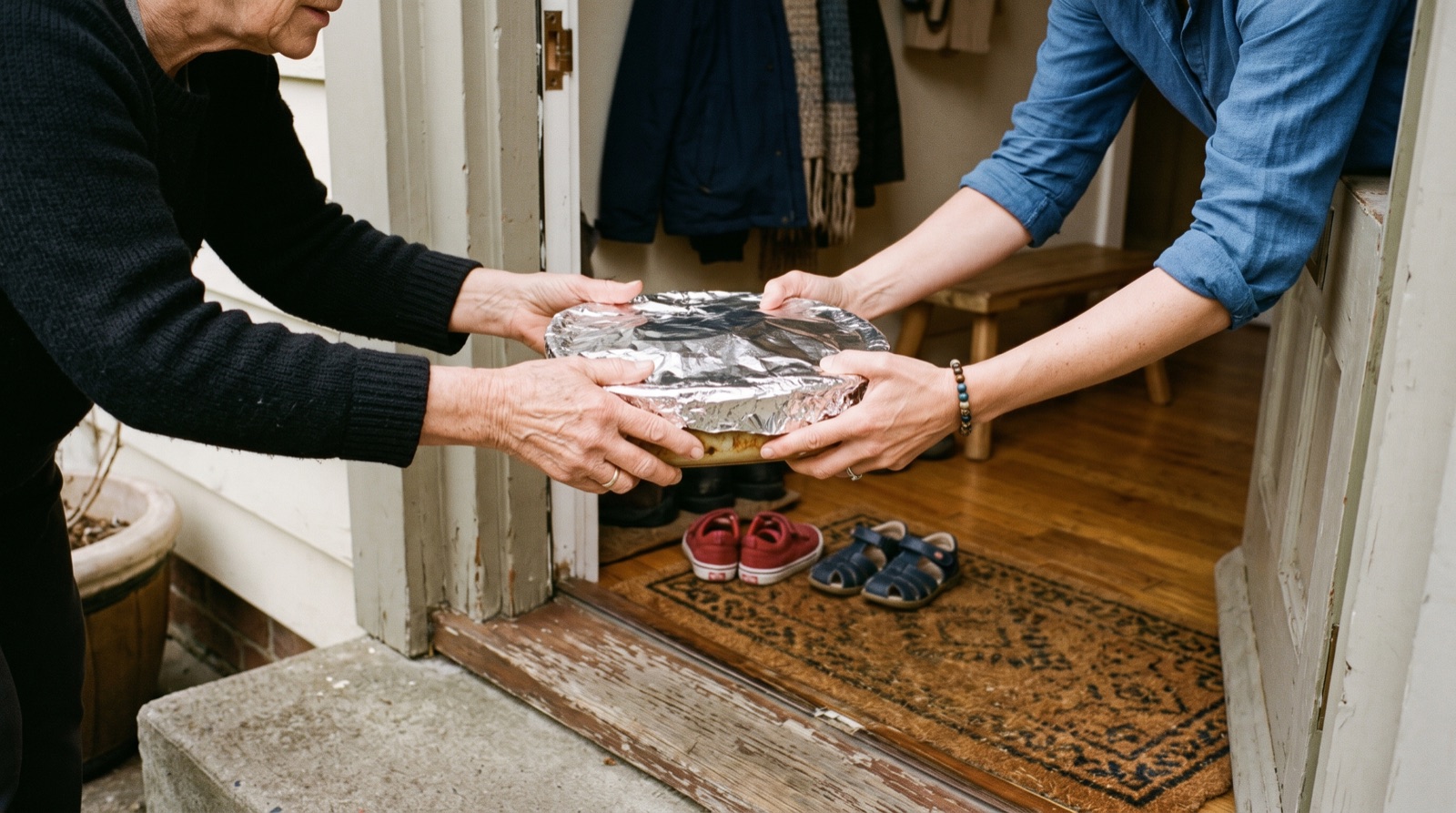
How to ask for help (and actually take it)
For the parent who always says "I'm fine, thanks." A practical guide to asking for help, with scripts you can copy, and how to accept it without guilt.
The Parent ChroniclesNov 12, 2026 · 4 min readThe neighbor who brought soup
Both kids had the stomach bug, my partner was away and I hadn't slept in two days. Someone knocked. It was the neighbor I'd only ever waved at, holding a pot of soup and a box of crackers. She said, "I could hear the coughing through the wall," and left before I could cry. I'm returning the pot tomorrow, full of cookies.